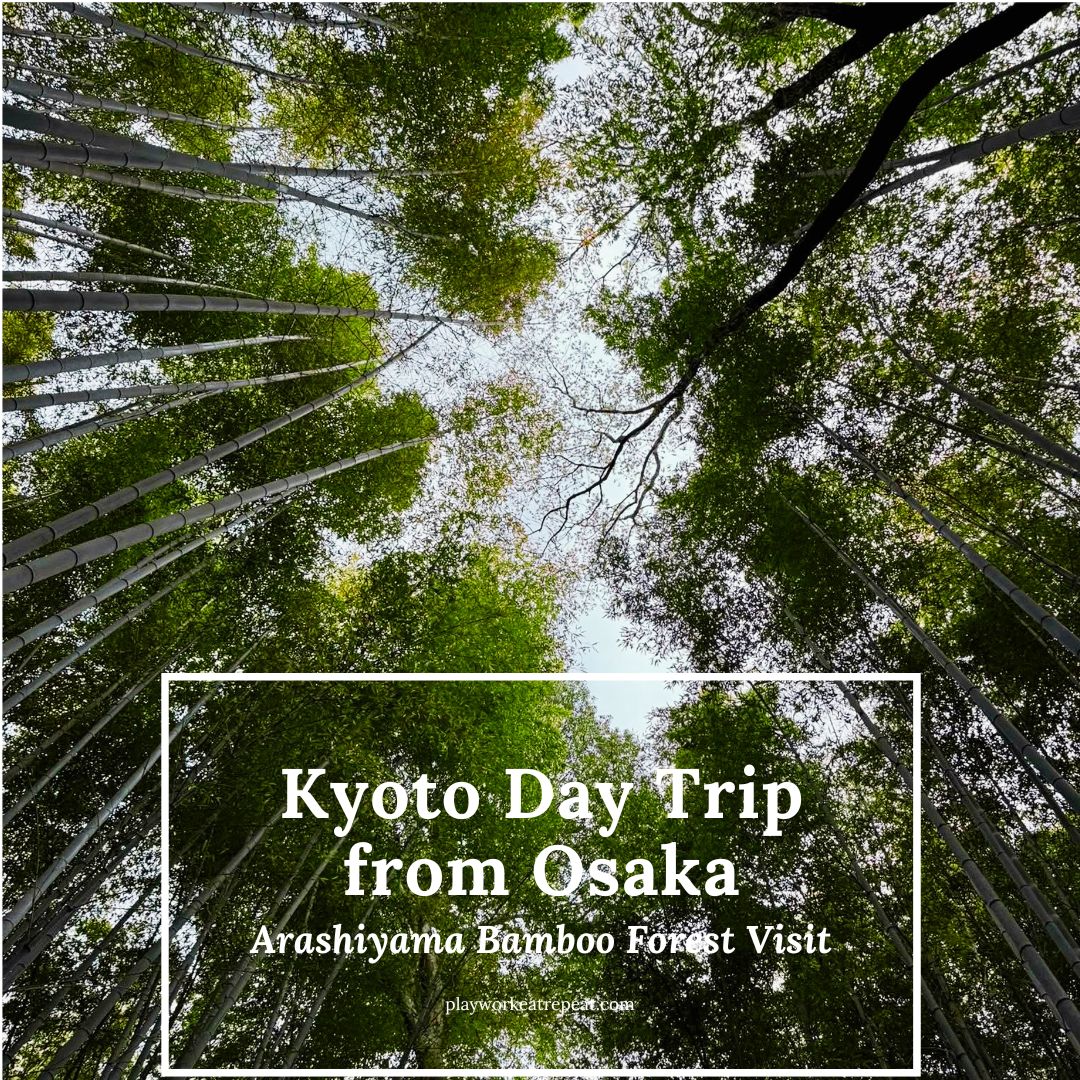
Kyoto Day Trip from Osaka
Our trip to Japan was a bit like a tasting menu. We’ve had a taste of so many amazing places, but there’s always one that you wish you could go back to for seconds. Kyoto was that place for me, and next time we visit Japan, I will definitely order the big Kyoto portion!
We planned a full day trip to Kyoto while we were in Osaka because it’s only about 30 minutes away by bullet train. Even though we only spent a day there, in true cousin connect travel style, we managed to pack quite a bit.
Breakfast at 7-Eleven
Our first stop was at 7-Eleven to get something to eat. Oh my God, 7-Elevens in Japan are something else. The range of fresh produce is incredible and the prices are incredibly cheap.


teamLab Biovortex Kyoto
After that, we spent over three hours at teamLab Biovortex, and like I said in the recap, I think that may have been the highlight of the trip.

On the way to Arashiyama
Next, we stopped for burgers at Wagyu to Worldwide before heading to Arashiyama to see the famous bamboo forest.

We took the train from central Kyoto to Saga-Arashiyama, and from there we walked through the streets towards the bamboo grove.


The whole area had such a peaceful and calm atmosphere, and everything seemed almost muted. Maybe it was because we were surrounded by so much greenery and mountains. It felt like a soundproof room. It’s a little hard to explain, but it’s the closest I can describe it.


Arashiyama Bamboo Forest
When we arrived at the bamboo forest, Sam, who visited Kyoto in 2024, told me that it was very short and that we would have finished it in no time. Either he remembered it differently, or my sense of distance was completely wrong, because it seemed much longer than I expected.

I kept asking him how he thought it was short, but he didn’t really remember. It’s a mystery.
Regardless, the bamboo forest was amazing, with towering bamboo trees all along the way.


I remember saying out loud, “I can’t believe I’m here.” » I think I say this a lot when I’m abroad. It usually says, “I can’t believe I survived the flight and landed,” and then, “I can’t believe I’m here,” every time I see an amazing sight. Hehe.
At the end of the bamboo forest, we came across a small temple nestled just off the path.

As we passed through Arashiyama, we reached a small overlook where we could see the mountains rising around the area. So beautiful and peaceful.


I almost made it (but I didn’t)
After the bamboo forest, we really wanted to visit the gardens of Tenryu-ji temple, which are located right next to the bamboo grove. But it was already too late, and although we sprinted to try to get there before the doors closed at 5 p.m., we missed it.
The famous Fushimi Inari Taisha Red Gates are also in Kyoto, but we needed another day to explore them as well. So these are two good reasons to return to Kyoto one day.
I think we had a great day trip to Kyoto. It really was so beautiful and one of those days that seemed like a lot, but still not enough at the same time. I hope to visit you again, Kyoto…you truly stole my heart on this trip.
PakarPBN
A Private Blog Network (PBN) is a collection of websites that are controlled by a single individual or organization and used primarily to build backlinks to a “money site” in order to influence its ranking in search engines such as Google. The core idea behind a PBN is based on the importance of backlinks in Google’s ranking algorithm. Since Google views backlinks as signals of authority and trust, some website owners attempt to artificially create these signals through a controlled network of sites.
In a typical PBN setup, the owner acquires expired or aged domains that already have existing authority, backlinks, and history. These domains are rebuilt with new content and hosted separately, often using different IP addresses, hosting providers, themes, and ownership details to make them appear unrelated. Within the content published on these sites, links are strategically placed that point to the main website the owner wants to rank higher. By doing this, the owner attempts to pass link equity (also known as “link juice”) from the PBN sites to the target website.
The purpose of a PBN is to give the impression that the target website is naturally earning links from multiple independent sources. If done effectively, this can temporarily improve keyword rankings, increase organic visibility, and drive more traffic from search results.
